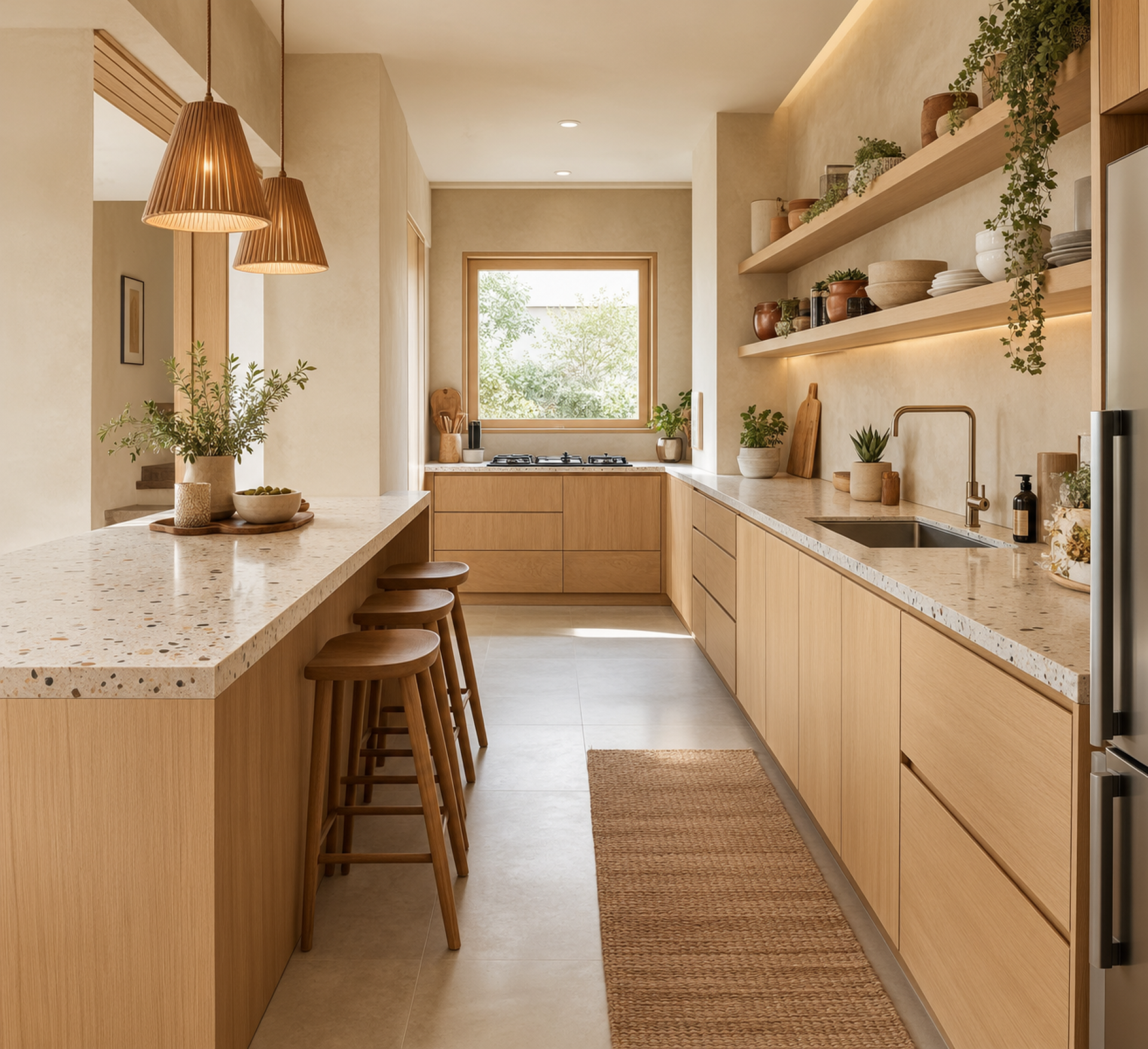
There’s a reason “warm wood” and “organic modern” keep trending at the top of every design mood board this year: after a decade of stark white kitchens and cold minimalism, homeowners are craving spaces that feel calm, tactile, and lived-in. Having spent years researching, photographing, and writing about residential interiors — and personally renovating two kitchens of my own — I can say with confidence that the organic modern kitchen isn’t a passing fad. It’s a correction. It brings back texture, natural material, and a sense of craftsmanship, while still keeping the clean lines and functional layouts that make a kitchen work hard for a busy household.
If you’ve been searching for modern kitchen ideas that feel warm rather than sterile, this guide walks through five real-world approaches — from sun-drenched open-plan layouts to moody Japandi-inspired corners — each with practical takeaways you can actually apply to your own renovation or refresh.
What Makes a Kitchen “Modern Organic”?
Before diving into the five ideas, it helps to define the style. A modern organic kitchen blends:
- Natural materials — solid wood, stone, rattan, linen, and clay-based plasters instead of high-gloss laminate or heavily veined synthetic surfaces.
- Warm neutral palettes — think oatmeal, terracotta, sand, walnut, and moss green rather than stark white or cool gray.
- Clean, uncluttered forms — flat-panel or slab cabinetry, minimal hardware, and simple geometry that lets the materials speak for themselves.
- Connection to the outdoors — large windows, garden views, and greenery brought inside through potted plants or trailing vines.
The result is a kitchen that photographs beautifully but, more importantly, feels genuinely comfortable to cook and gather in every day. Below are five distinct directions within this style, each backed by real design examples.
1. Minimalist Warm Walnut & Marble Island
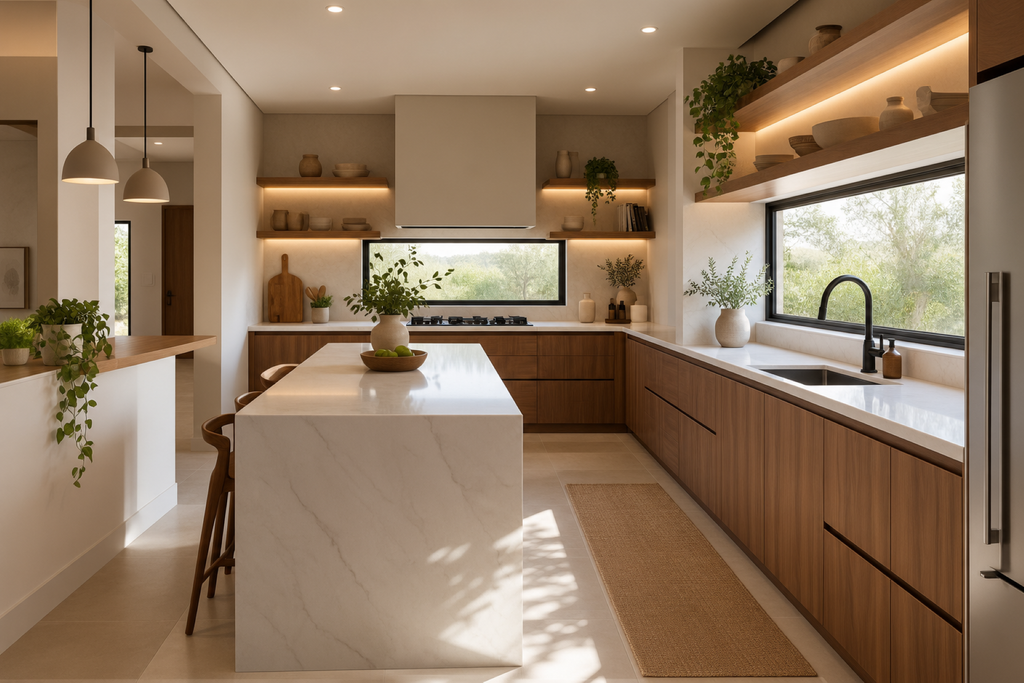
The first approach pairs rich walnut cabinetry with a crisp white marble-look island, creating a quiet contrast between warmth and lightness. This is one of the most popular modern kitchen ideas for homeowners who want an organic feel without sacrificing a bright, airy atmosphere.
Key design elements:
- Handleless walnut base cabinets running along the perimeter for a streamlined look
- A waterfall-edge marble (or engineered quartz with marble veining) island as the visual anchor
- Black matte fixtures for the sink and faucet to ground the palette
- Open wood shelving styled with ceramics and greenery instead of upper cabinets, which keeps the room feeling open
Why it works: The pairing of dark wood and pale stone is one of the most timeless combinations in kitchen design because it balances warmth and brightness in equal measure. It photographs well in both daylight and evening lighting, which is part of why it remains a go-to reference point for designers building organic modern spaces. If your kitchen doesn’t get much natural light, this combination is especially effective — the marble island reflects available light while the walnut keeps the room from feeling clinical.
Practical tip: If a full marble island isn’t in your budget, a quartz surface with subtle veining achieves 90% of the visual effect at a fraction of the maintenance and cost, and it’s far more forgiving with daily spills.
2. Japandi-Style Light Oak Kitchen
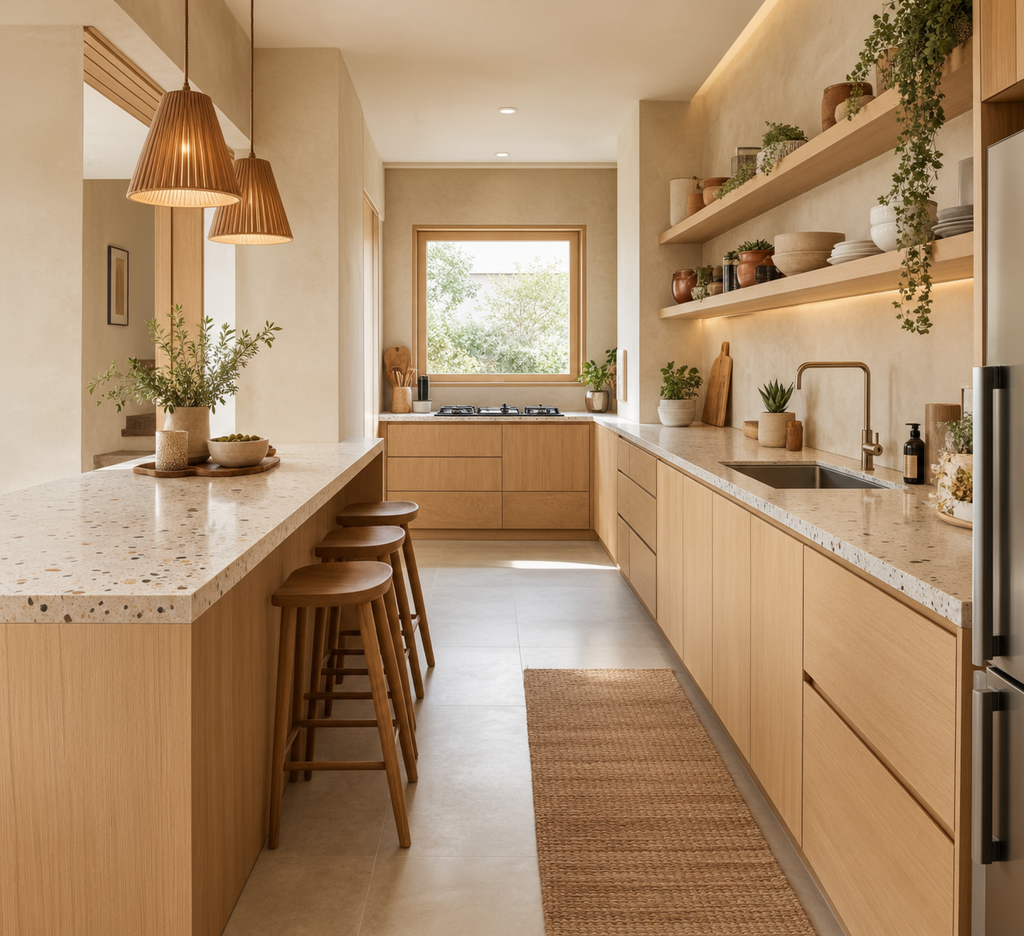
Japandi — the fusion of Japanese minimalism and Scandinavian warmth — has become one of the defining aesthetics in organic modern design. This version leans into light oak cabinetry, terrazzo-style countertops, and a soft, sand-toned wall finish that feels serene rather than sparse.
Key design elements:
- Light oak slab cabinetry with minimal visible hardware
- Terrazzo or flecked-stone countertops for subtle texture and visual interest
- Woven rattan pendant lighting to reinforce the natural material story
- Floating wood shelves layered with handmade pottery, glassware, and trailing plants
- A soft jute or woven runner rug to add warmth underfoot
Why it works: Light oak reflects far more light than darker wood tones, which makes this style ideal for galley kitchens or spaces with limited windows. The Japandi approach specifically prioritizes negative space — meaning less on the counters, fewer decorative objects, and a general sense of calm. It’s a favorite among people searching for modern kitchen ideas that feel restorative rather than showy.
Practical tip: Keep countertop appliances to a minimum and store everyday tools in drawers rather than on open shelves. Japandi kitchens rely on restraint — the moment the surfaces get cluttered, the calm effect disappears.
3. Earthy Modern Kitchen with Fluted Wood & Rattan
This is arguably the most maximalist of the five ideas, though it stays firmly rooted in organic modern principles. Deep forest-green walls, textured tile, and a fluted wood island bring drama and depth, while a glass roof and cascading houseplants keep the space feeling alive.
Key design elements:
- A fluted (reeded) wood island panel for tactile, architectural texture
- Dark green painted walls paired with a matching statement range hood
- Zellige-inspired or reclaimed-look tile as a backsplash accent
- Woven rattan counter stools for warmth and softness against the dark tones
- Skylights and hanging plant installations to bring in light and life
Why it works: Fluted wood paneling has become one of the standout textures in contemporary kitchen design because it catches light differently depending on the viewing angle, adding dimension without adding pattern or color. Combined with a deep green wall — a color strongly associated with nature and biophilic design — the kitchen feels grounded and immersive rather than flat. This is a strong option for homeowners who want their kitchen to double as a statement room, not just a functional space.
Practical tip: If you’re nervous about committing to a dark wall color, test it first on the range hood or a single accent wall rather than painting the entire room. It gives you the drama without the full commitment, and it’s easy to reverse if you change your mind.
4. Japandi Dark Teak & Warm Neutral Tones
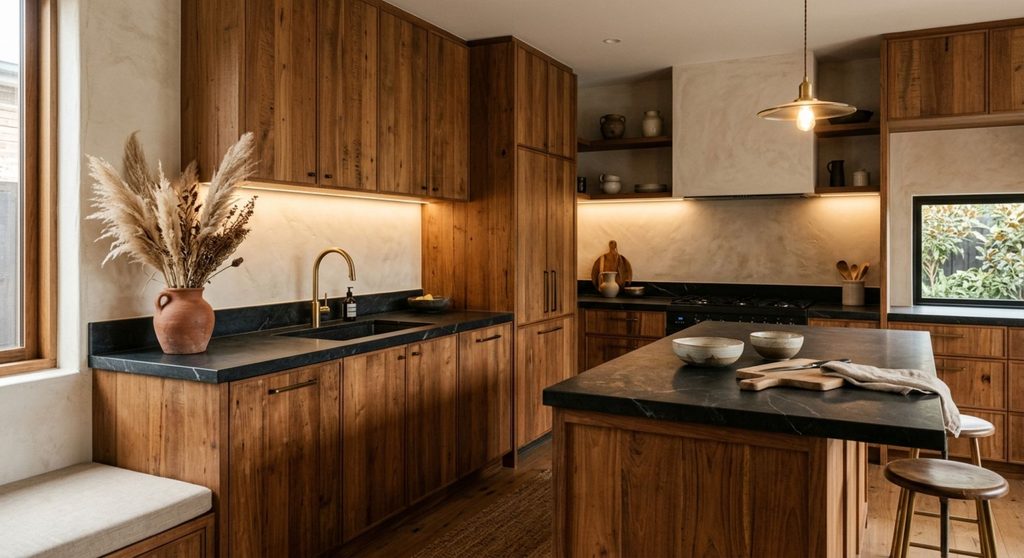
A cozier, more intimate cousin of idea #2, this version swaps light oak for deep teak or walnut cabinetry and pairs it with black soapstone countertops. The result feels more like a boutique hotel kitchen than a strictly minimalist one — warm, moody, and inviting.
Key design elements:
- Rich teak or walnut cabinetry with visible wood grain
- Honed black soapstone or dark stone countertops for contrast
- Warm brass or unlacquered brass fixtures to soften the darker palette
- Integrated under-cabinet and toe-kick lighting for ambient warmth
- Handmade ceramic bowls and a terracotta vessel as styling accents
Why it works: Dark wood kitchens can easily feel heavy or dated if not balanced correctly, but this iteration solves that by relying on warm lighting — under-cabinet strips, brass fixtures, and a single statement pendant — to keep the space from feeling closed in. It’s a particularly good fit for kitchens with generous natural light during the day and a desire for a cozy, cocooning feel in the evening.
Practical tip: Soapstone is naturally heat- and stain-resistant and develops a soft patina over time, which actually enhances the organic, lived-in look this style is going for — unlike more delicate natural stones that require sealing and careful upkeep.
5. Sun-Drenched Open-Plan Rustic-Modern Kitchen
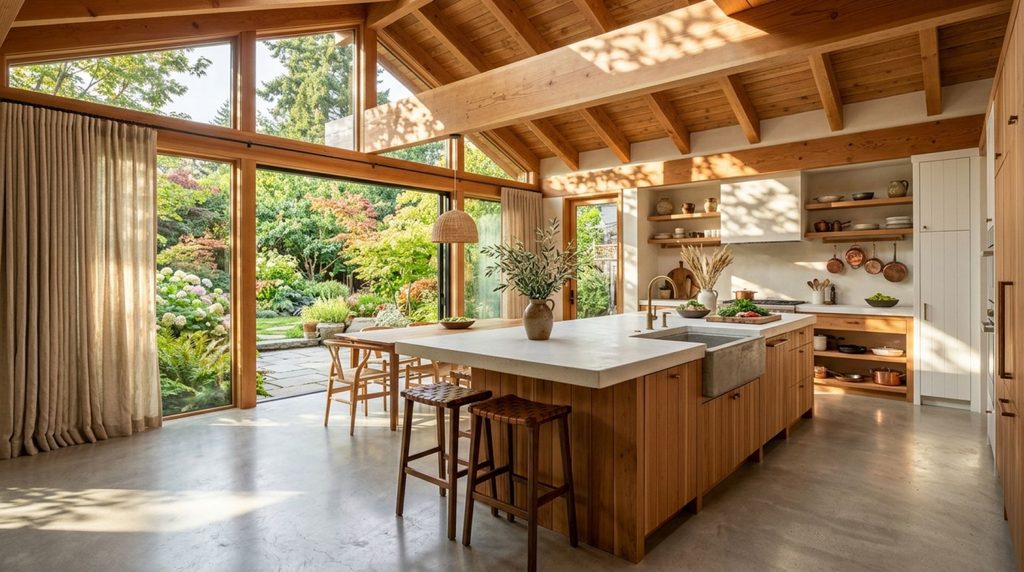
The final idea is built around architecture as much as finishes: soaring wood-beamed ceilings, floor-to-ceiling glass doors, and a large central island that opens directly onto a garden. It’s the most “open-plan” of the five and works best in homes with generous square footage or an indoor-outdoor lifestyle.
Key design elements:
- Exposed wood beam or vaulted ceiling for architectural warmth
- Full-height glass doors or windows connecting the kitchen to an outdoor patio or garden
- A large central island in a lighter wood tone with an integrated farmhouse sink
- Open wood shelving displaying everyday ceramics, cookware, and dried botanicals
- Woven counter stools and linen drapery to soften the hard architectural lines
Why it works: This layout leans on natural light as the primary design feature — the wood tones, stone counters, and neutral palette are almost secondary to the sheer volume of daylight pouring through the glazing. It’s an especially popular reference point for renovators researching modern kitchen ideas for homes with garden or backyard access, since it blurs the line between indoor and outdoor living far more than a typical kitchen layout.
Practical tip: If you’re adding large glass doors, invest in high-quality, well-insulated glazing. It’s the difference between a kitchen that feels bright and comfortable year-round versus one that becomes uncomfortably hot or cold depending on the season.
How to Choose the Right Organic Modern Style for Your Space
With five distinct directions on the table, here’s a simple way to narrow it down:
- Small or low-light kitchen? Lean toward the light oak Japandi style (#2) or the walnut-and-marble combination (#1) — both maximize brightness.
- Want your kitchen to feel like a statement room? The fluted wood and rattan design (#3) offers the most personality and visual drama.
- Craving a cozy, evening-friendly space? The dark teak Japandi kitchen (#4) uses warm lighting and rich tones to create an intimate atmosphere.
- Have access to outdoor space and lots of natural light? The open-plan rustic-modern layout (#5) is built specifically to take advantage of that connection.
Regardless of which direction you choose, the common thread across all five is restraint paired with texture — natural materials, warm tones, and just enough greenery to keep the space feeling alive. That combination is exactly why these modern kitchen ideas continue to resonate: they don’t chase trends for the sake of novelty, they simply bring the kitchen back to something that feels human, tactile, and welcoming.
Final Thoughts
A kitchen renovation is one of the biggest investments most homeowners will make in their home, so it’s worth choosing a direction that will feel timeless rather than trend-driven. Organic modern design, in all five of the variations above, succeeds because it prioritizes materials and light over passing fads — walnut, oak, stone, and rattan don’t go out of style the way a particular cabinet color might. Whichever version speaks to you, start with the material palette first, then layer in lighting, greenery, and styling details to bring the whole space together.


Leave a Reply